The material shift
How modern life quietly changed our exposure landscape
For most of human history, the materials surrounding daily life were relatively simple.
Homes were built from wood, stone, clay, and metal. Clothing came from cotton, wool, leather, or linen. Food was stored in ceramic vessels, glass jars, or metal tins. Even when pollution occurred, the substances involved were usually familiar ones: smoke from fires, mineral dust, or metal residues from early industry.
The physical environment had its hazards, but its basic material composition changed slowly.
That stability did not last.
Over the past century, the human environment has been transformed by a new class of materials. Plastics, polymer coatings, engineered foams, synthetic textiles, and composite materials now appear in nearly every object that surrounds modern life. They protect food, enable sterile medical equipment, reduce shipping weight, and form the backbone of electronics and transportation systems.
They also changed something less visible: the kinds of particles that circulate through the environments people inhabit, surrounding the materials that encase our food and filling the spaces where daily life unfolds.
Understanding that shift requires stepping back from individual studies and looking at a broader pattern in Earth history. Increasingly, scientists describe the present era as the Anthropocene, a period in which human activity has become a major force shaping planetary systems [1-4].
A planet reshaped by materials
The Anthropocene concept emerged from Earth system science as researchers began recognizing the scale of human influence on the planet. Human activity now affects atmospheric chemistry, ocean circulation, global nutrient cycles, and the structure of ecosystems across continents [2-4]. Industrialization, urbanization, and large scale agriculture have transformed landscapes and altered the physical and chemical composition of the environment.
Among the clearest markers of this transformation is the growing presence of synthetic materials.
Plastic production began in earnest in the early twentieth century but expanded dramatically after the Second World War. Lightweight polymers quickly proved useful across nearly every industrial sector. Packaging, construction materials, electronics housings, textiles, vehicle components, and medical devices increasingly relied on polymer based materials.
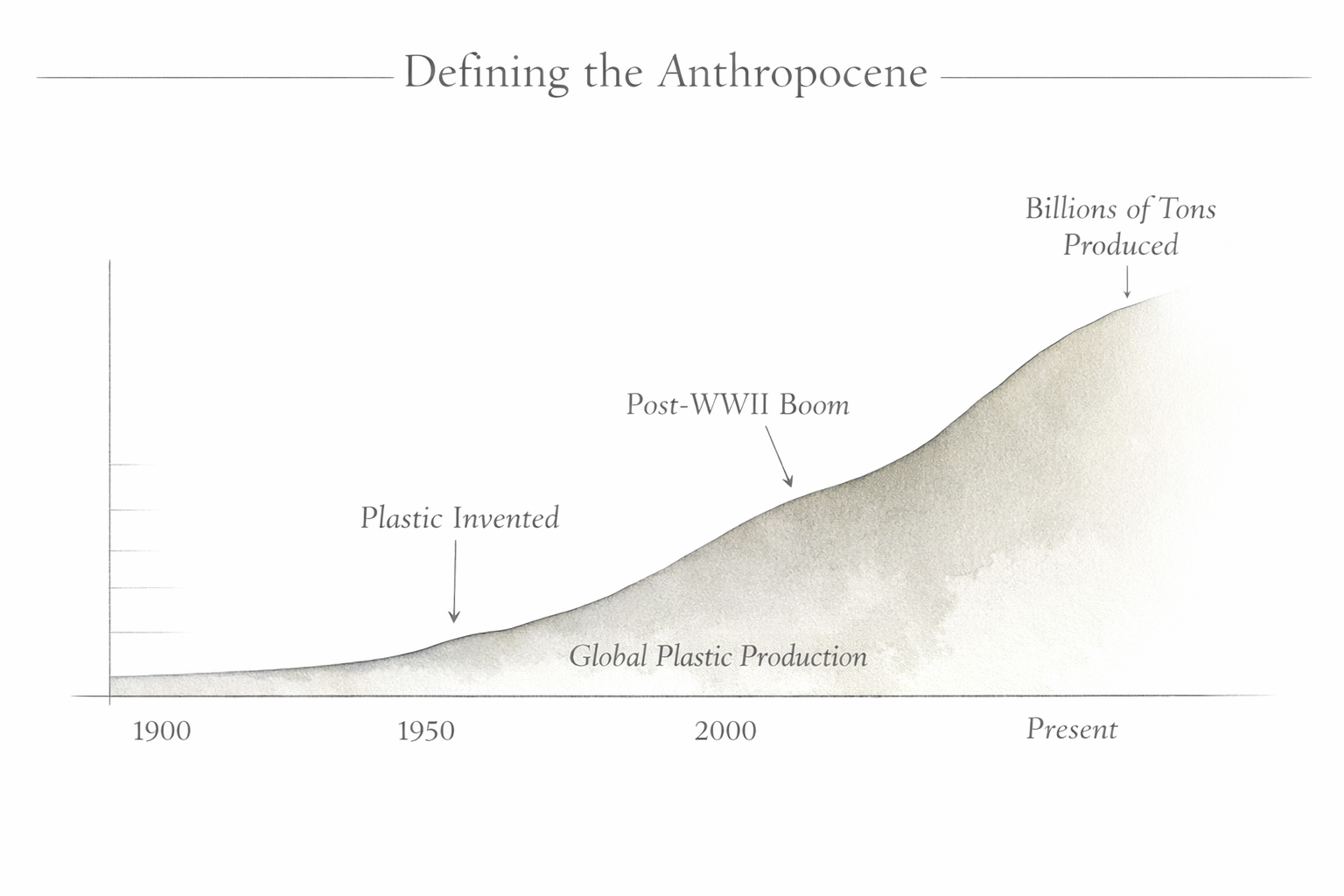
Today global plastic production exceeds hundreds of millions of tons each year [5].
The scale of this transformation has led some geologists to suggest that plastics themselves may become a defining geological signature of the Anthropocene, preserved as fragments in sediments and soils around the world [1,4].
But the environmental significance of plastics does not lie only in their abundance. It also lies in how they age.
When materials become particles
All materials break down over time.
Stone erodes under wind and water. Metal slowly oxidizes. Natural fibers fray as they wear. The process may take years or centuries, but fragmentation is inevitable.
Synthetic polymers follow the same rule.
Under sunlight, friction, heat, and mechanical stress, larger plastic objects gradually break into smaller fragments. Packaging films, plastic bottles, textile fibers, and tire surfaces all shed microscopic debris as they age.

These fragments are now commonly referred to as microplastics when smaller than five millimeters, and nanoplastics when they reach microscopic or nanoscale dimensions [6-9].
Once particles become small enough, they can move through the environment in ways larger materials cannot. They can circulate through air, settle into soil, travel through waterways, or accumulate in dust [7-9].
This process unfolds quietly and continuously. Each individual object releases only small quantities of material, but across billions of products and surfaces the cumulative result is a diffuse background of polymer particles circulating through modern environments.
In many ways, this particulate landscape reflects the materials that define the modern world.
The hidden geography of everyday life
When scientists trace the sources of environmental microplastics, they often lead back to ordinary features of daily life.

Synthetic textiles are one example. Polyester, nylon, and acrylic fibers are now widely used in clothing, carpets, and upholstery. During washing, drying, and everyday wear, these fabrics shed microscopic fibers that can enter wastewater systems or become airborne particles [10].
Transportation systems provide another source. Modern vehicle tires contain complex blends of synthetic rubber and polymer additives designed to withstand friction and heat. As vehicles travel, small amounts of tire material abrade against road surfaces, producing microscopic fragments that accumulate in road dust and surrounding environments [11].
Packaging and consumer products contribute as well. Plastic films, containers, coatings, and utensils can release particles through abrasion, heating, or mechanical stress during routine use [12].
Individually, these processes are almost invisible. Collectively, they create a steady flow of microscopic particles entering the environment.
This pattern illustrates a broader principle of environmental science: exposure landscapes often emerge from many small processes rather than a single dramatic source.
The indoor world
Perhaps the most significant shift in human exposure environments is not just what materials surround us, but where we spend our time.
For most of human history, daily life occurred largely outdoors. Work, travel, food preparation, and social life unfolded in open environments where particles dispersed widely.
Modern societies are different.
In industrialized countries, people now spend the majority of their time indoors. Homes, offices, schools, and vehicles form the primary environments in which daily life occurs.
These indoor environments contain a dense concentration of synthetic materials: carpets, upholstered furniture, electronics, insulation foams, flooring materials, paints, adhesives, and countless plastic objects.
As these materials age and experience normal wear, they release microscopic fragments that mix with other components of indoor dust.
Indoor dust is already a complex mixture containing soil particles, mineral fragments, plant material, and human skin cells. Plastic fibers and fragments have now been identified as another component of this mixture [13-14].
In some cases, measurements suggest indoor environments may contain higher concentrations of airborne microplastic fibers than outdoor air [13]. This is not surprising. Enclosed spaces concentrate the materials present within them.
The indoor environment therefore represents one of the primary settings in which modern exposure landscapes unfold.
Following the particles
As analytical tools have improved, scientists have begun tracking where these particles travel.
Microplastics have now been identified in marine ecosystems, river sediments, soils, atmospheric dust, and food systems [6-9]. They have also been detected in human biological samples, including blood, lung tissue, placenta samples, urine, and stool [15-18].
These findings often attract public attention because they reveal how thoroughly modern materials circulate through environmental systems.
But scientists emphasize that detection alone does not determine risk.
Environmental health research typically progresses in stages. First comes environmental detection, identifying where materials occur. Next come mechanistic studies exploring how those materials interact with biological systems. Only later do long term epidemiological studies begin to clarify whether particular exposures produce measurable health effects.
Microplastics research is currently moving through the earliest stages of this process.
Researchers are still refining detection methods, identifying exposure pathways, and exploring how particles behave in biological environments.
A familiar scientific pattern
This gradual process may feel uncertain, but it is not unusual.
Environmental health science has encountered similar situations many times before. The biological impacts of lead exposure, tobacco smoke, airborne particulate pollution, and industrial chemicals all became clear only after years or decades of accumulating evidence.
Each case followed a similar trajectory.
Scientists first recognized the widespread presence of a substance in the environment. Researchers then explored biological mechanisms in laboratory systems. Eventually, long term population studies revealed patterns linking exposure and health outcomes.
Microplastics research appears to be following a similar path.
The field is currently focused on mapping the distribution of particles and understanding how they interact with environmental and biological systems.
As measurement technologies improve, the scientific picture will continue to sharpen.
Living in the polymer age
Viewed from a broader historical perspective, the story of microplastics is not simply about pollution.
It is about materials.
Human civilizations have always been shaped by the materials they learn to produce and control. Archaeologists often describe historical periods according to their dominant technologies: the Stone Age, the Bronze Age, the Iron Age.
Modern society could reasonably be described as the Polymer Age.
Synthetic polymers have transformed medicine, food preservation, transportation, and communication technologies. They are among the most versatile materials ever developed by human industry.
But like all materials, they fragment over time.
As those fragments disperse through air, water, soil, and indoor environments, they become part of the broader environmental landscape that scientists are now beginning to map.
A landscape still coming into focus
Research into microplastics and environmental exposure is still in its early stages.
Scientists are continuing to refine measurement techniques, improve particle detection methods, and explore how different polymer types behave in biological systems. Many questions remain open, including which particle sizes are most biologically relevant and how long term exposure patterns may influence health.
What is already clear, however, is that the material environment of the modern world differs profoundly from that of earlier centuries.
The fabrics, packaging, infrastructure, and technologies that define contemporary life are built from materials that fragment and disperse in ways earlier materials rarely did.
Understanding how those materials interact with environmental systems is one of the emerging scientific questions of the Anthropocene.
And as with many questions in environmental science, the answers will likely emerge slowly through careful observation, improved measurement, and sustained research.
References
- 1.↑ Lewis, S. L. & Maslin, M. A. Defining the Anthropocene. Nature 519, 171–180 (2015). PubMed
- 2.↑ Steffen, W. et al. The Anthropocene: From Global Change to Planetary Stewardship. AMBIO 40, 739 (2011). PubMed
- 3. Steffen, W., Broadgate, W., Deutsch, L., Gaffney, O. & Ludwig, C. The trajectory of the Anthropocene: The Great Acceleration. Anthr. Rev. 2, 81–98 (2015).
- 4.↑ Steffen, W., Grinevald, J., Crutzen, P. & McNeill, J. The Anthropocene: conceptual and historical perspectives. Philos. Trans. R. Soc. A: Math., Phys. Eng. Sci. 369, 842–867 (2011). PubMed
- 5.↑ Geyer, R., Jambeck, J. R. & Law, K. L. Production, use, and fate of all plastics ever made. Sci. Adv. 3, e1700782 (2017). PubMed
- 6.↑ Campanale, C., Massarelli, C., Savino, I., Locaputo, V. & Uricchio, V. F. A Detailed Review Study on Potential Effects of Microplastics and Additives of Concern on Human Health. Int. J. Environ. Res. Public Heal. 17, 1212 (2020). AtlasPubMed
- 7.↑ Prata, J. C. Microplastics and human health: Integrating pharmacokinetics. Crit. Rev. Environ. Sci. Technol. 53, 1489–1511 (2023); Prata, J. C. Airborne microplastics: Consequences to human health? Environ. Pollut. 234, 115–126 (2018). AtlasPubMed
- 8. Cox, K. D. et al. Human Consumption of Microplastics. Environ. Sci. Technol. 53, 7068–7074 (2019). AtlasPubMed
- 9.↑ Dzierżyński, E. et al. Microplastics in the Human Body: Exposure, Detection, and Risk of Carcinogenesis: A State-of-the-Art Review. Cancers 16, 3703 (2024). AtlasPubMed
- 10.↑ Chouchene, K. et al. Unraveling the ecological impact of textile microfibers: Current knowledge and research challenges. Mar. Pollut. Bull. 226, 119358 (2026). AtlasPubMed
- 11.↑ Kole, P. J., Löhr, A. J., Belleghem, F. V. & Ragas, A. Wear and Tear of Tyres: A Stealthy Source of Microplastics in the Environment. Int. J. Environ. Res. Public Heal. 14, 1265 (2017). AtlasPubMed
- 12.↑ Hussain, K. A. et al. Assessing the Release of Microplastics and Nanoplastics from Plastic Containers and Reusable Food Pouches: Implications for Human Health. Environ. Sci. Technol. 57, 9782–9792 (2023). AtlasPubMed
- 13.↑ Vianello, A., Jensen, R. L., Liu, L. & Vollertsen, J. Simulating human exposure to indoor airborne microplastics using a Breathing Thermal Manikin. Sci. Rep. 9, 8670 (2019). AtlasPubMed
- 14.↑ Salthammer, T. Microplastics and their Additives in the Indoor Environment. Angew. Chem. Int. Ed. 61, e202205713 (2022). AtlasPubMed
- 15.↑ Leslie, H. A. et al. Discovery and quantification of plastic particle pollution in human blood. Environ. Int. 163, 107199 (2022). PubMed
- 16. Ragusa, A. et al. Plasticenta: First evidence of microplastics in human placenta. Environ. Int. 146, 106274 (2021). AtlasPubMed
- 17. Amato-Lourenço, L. F. et al. Presence of airborne microplastics in human lung tissue. J. Hazard. Mater. 416, 126124 (2021). AtlasPubMed
- 18.↑ Pironti, C. et al. First Evidence of Microplastics in Human Urine, a Preliminary Study of Intake in the Human Body. Toxics 11, 40 (2022). AtlasPubMed
Sign in to start a discussion.