Nanoplastics, microplastics, and human exposure
Why the smallest plastic particles may matter the most
Plastic pollution is usually pictured as something far away.
A bottle floating in the ocean.
A bag caught in a tree.
A landfill on the edge of town.
But the most relevant form of plastic pollution is often invisible.
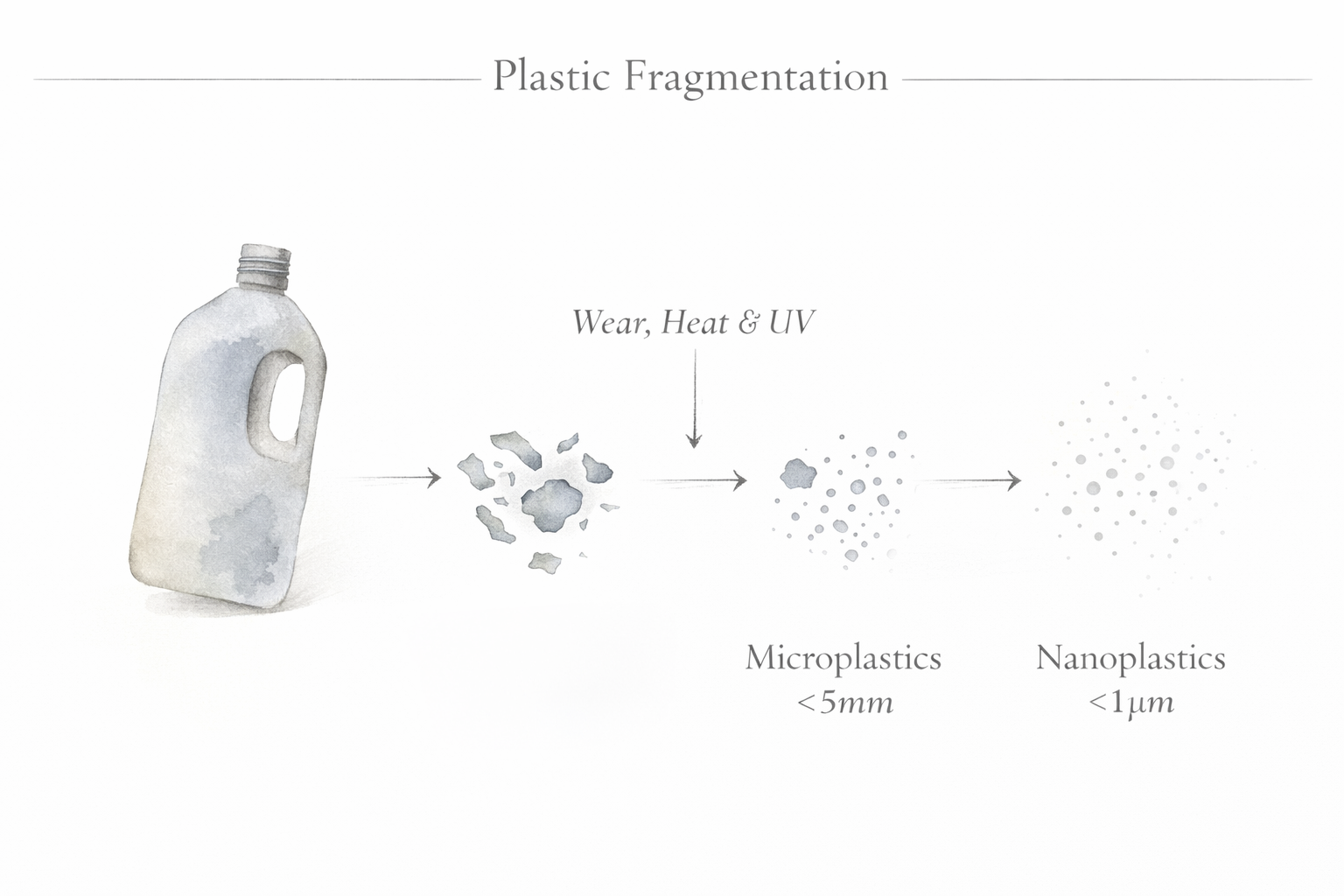
As plastic breaks down, they fragment into extremely small particles known as microplastics and nanoplastics. These particles are now found in water, soil, food, air, and increasingly within us.
Scientists have detected plastic particles in human blood, lungs, placenta, and brain tissue [1-4]. What was once thought to remain outside the human body is now known to move through our environment, into us, and interact with our biology [5-6]. And while the absolute quantity of microplastics and nanoplastics within us is still up for debate, the fact remains that they are within us and interacting with our biology at a molecular level.
Understanding where these particles come from and how we may encounter them in daily life is an important step towards understanding how to reduce exposure.
This paper explores what microplastics and nanoplastics are, how they form, where humans encounter them, and why their small size may make them biologically important.
The size of the problem
Today, global plastic pollution exceeds 400 million tons per year, and much of it eventually fragments into microscopic particles [11-12]. Plastics rarely disappear. Instead, they slowly fragment.
Over time, larger plastic objects break into smaller and smaller pieces until they reach microscopic scales [13]. And as those microscopic particles continue to fragment over time, the total number of particles increases dramatically even if the total mass of plastic remains the same.
Two terms are commonly used to describe these particles [14-15].
Microplastics: plastic particles smaller that 5 millimeters
Nanoplastics: plastic particles between 1 nanometer and 1 micrometer in size
To put this scale into perspective:
- A human hair is roughly 80 to 100 micrometers wide
- Many bacteria measure 1 to 5 micrometers in diameter
- Human cells often are in 10s of micrometers in diameter
Thus, nanoplastics are smaller than individual cells.

At these scales, plastic no longer behaves like the material or debris we see daily. It behaves more like a particle or a fiber than can directly interact with biological systems.
Why size matters
Smaller particles behave differently.
As plastic fragments, several important physical and biological properties change.
First, surface area increases [16]. When particles become smaller, their surface area relative to their mass increases dramatically. This makes them more reactive and more capable of interacting with biological molecules, including nucleic acids, proteins, lipids, and sugars [17].
Second, particles remain suspended [18-20]. Nanoplastics can stay suspended in air or water for long periods of time rather than settling quickly like larger fragments. Because of this, they travel easily through environmental systems and indoor environments.
Third, biological barriers become permeable [21-22]. Some studies suggest that nanoscale particles may cross biological barriers such as intestinal tissue or even the blood-brain barrier. And once crossed, they can accumulate.
This does not mean that every particle behaves this way. But the possibility changes how scientists think about plastic exposure.
Instead of simply passing through the body, very small particles may interact with it in ways larger fragments cannot [23-24].
Where microplastics and nanoplastics come from
Microplastics and nanoplastics originate in two main ways, typically classified as primary and secondary [13].
Primary particles are those that are intentionally produced in small forms for industrial use. These particles may be used in coatings, abrasives, or specialized materials. However, they represent only a portion of total plastic particles in circulation.
Secondary particles come from the breakdown of larger plastics [25-28]. Several forces drive this process both in our environment and in our societal systems, including mechanical wear, heat and chemical exposure, and sunlight, particularly ultraviolet (UV) radiation.

These forces can act in the environment, for example in the ocean or soil. Or in processing plants, for example as food is wrapped and stored in plastic.
Human exposure: not just an environmental issue
Microplastics and nanoplastics are often framed as an environmental issue. As a result, the conversations tend to focus on plastic exposure from environmental sources and pollution, such as oceans, rivers, and soils.
And they absolutely are an environmental issue.
But human exposure does not come only from distant ecosystems. It also comes from everyday systems people rely on and interact with constantly.
Plastic particles can originate from food packaging, drinking water and plumbing, synthetic clothing, household materials, indoor dust, transportation systems and tires [5,29-32]. And that is not an all encompassing list.
These exposures add together.
Understanding microplastics therefore means understanding the environments people live in every day.
Plastics in manufacturing and processing
Food is one of the most common ways humans interact with plastics.
Plastic packaging has become a central feature of modern food systems. It protects food, extends shelf life, reduces contamination, and allows products to be transported safely across long distances.
But plastic materials can shed microscopic particles through normal use.
Some particles originate during the manufacturing of the plastic itself [33-35]. Polymer production does not always produce perfectly uniform materials. Plastic products can contain small fragments or particles introduced during manufacturing and processing. Additional particles can also be generated during packaging operations such as cutting, trimming, sealing, and heat processing.
These particles can enter food systems during manufacturing, packaging, transportation, or everyday use.
Common food-contact plastics include beverage bottles, food storage containers, plastic wraps and films, disposable utensils, and plastic-lined packaging materials [36-38]. Routine actions such as opening bottles, tearing packaging, or squeezing containers can generate small fragments through mechanical wear.
Heat can further accelerate this process [39-43]. Heating food in plastic containers or exposing packaging materials to elevated temperatures may increase the release of microscopic plastic particles.

One widely cited study found that steeping certain plastic-based tea bags released billions of microplastic and nanoplastic particles into a single cup of tea [44].
Plastic contamination can also originate from unexpected sources. For example, some studies have found microscopic plastic particles in beverages stored in glass bottles, originating from painted caps or bottle seal coatings rather than the bottle itself [37].
Occasionally, food products have even been voluntarily recalled due to the presence of visible plastic fragments introduced during processing or packaging [45-46].
Food safety systems have historically focused on chemical migration from packaging materials. The release of particulate plastics into food systems is a newer area of research that scientists are only beginning to examine more closely.
Even in routine manufacturing videos, small plastic fragments can sometimes be visible during packaging processes [47]. While these visible particles are relatively large compared to microscopic plastics, they illustrate how mechanical processes can introduce plastic fragments into food production environments.
Our homes: synthetic textiles and indoor dust
Many materials inside modern homes contain plastics or synthetic polymers.
Clothing, carpets, upholstery, furniture fabrics, paints, varnishes, and other household materials are often made with synthetic fibers such as polyester, nylon, acrylic, spandex, or vinyl.
Over time, these materials can shed extremely small fragments through normal wear and use. These particles gradually accumulate in household dust and indoor air.
Because people spend the majority of their time indoors, inhalation of these microscopic fibers may represent an important pathway for exposure [5,48-50]. Studies examining indoor environments have identified thousands of plastic fibers suspended within a single cubic meter of indoor air.

Household dust is made up of many components. It often contains a mixture of organic material such as skin cells, natural minerals like silica, and fibers from both natural and synthetic materials. Plastic particles typically make up only a portion of that mixture.
However, even small amounts of continuous exposure can become meaningful when they occur daily over long periods of time. Environmental health research has shown similar patterns with other materials, including heavy metals like lead, where low levels of repeated exposure can accumulate in the body over time.
Transportation and urban particles
Another significant source of microplastic and nanoplastic particles comes from something most people encounter every day: vehicle tires [31,51-53].
Modern tires are complex engineered materials made from a mixture of synthetic polymers and rubber compounds. These materials are designed to be durable and flexible, but like any surface in constant contact with friction, they slowly wear down over time.
As vehicles move, the friction between tires and road surfaces gradually abrades small amounts of tire material. This process produces microscopic particles that accumulate on roadways or are carried into the surrounding environment through air, rainwater runoff, and soil.

These particles can enter waterways through stormwater systems, become suspended in atmospheric dust, or settle into nearby soils.
Researchers now consider tire wear particles to be one of the largest sources of microscopic synthetic particles in urban environments.
Sometimes discussions around these particles become focused on terminology. Some commentators point out that tire materials are technically rubber rather than traditional plastics. While this distinction can matter in certain technical contexts, it can also distract from the broader point.
Both plastics and many modern rubber materials are forms of synthetic polymers. At microscopic scales, these materials behave similarly as persistent particles in the environment.
The important observation is not the exact label applied to the material, but the growing presence of tiny synthetic particles moving through the environments we live in every day.
When plastics become biologically active
Not all plastic particles behave the same way.
At very small scales, nanoplastics may interact with biological systems in ways that larger particles cannot. Their size, chemistry, and surface properties allow them to behave more like biological particles than simple debris.
Several mechanisms help explain why.
Surface charge
The surface of most of our cells carries a slight negative electrical charge. This comes from the structure of the cell membrane itself. Cell membranes are made from molecules called phospholipids, which contain negatively charged phosphate groups that line the outer surface of the cell.
Because opposite electrical charges attract, positively charged particles are often more readily drawn toward cell surfaces [54-57]. Neutral or negatively charged particles can also interact with cells, though sometimes less strongly.
The charge of a plastic particle therefore influences how it interacts with cells and how easily it may be taken up into biological tissues.
Protein corona formation
When nanoplastics enter biological fluids such as blood or the digestive tract, proteins and other biological molecules quickly bind to their surfaces.
Scientists refer to this coating as a protein corona [58-59].
This protein layer changes how the particle behaves. It can affect how the immune system recognizes the particle, how it moves through the body, and whether cells interact with it.
In many ways, the particle becomes biologically “disguised,” wearing a coat of the body’s own proteins.
Cellular uptake
Nanoplastics are small enough to be internalized by cells through normal cellular processes [60].
Cells regularly take in particles from their surroundings through mechanisms such as endocytosis, which allows the cell membrane to fold inward and bring external materials inside.
Once inside the cell, particles may interact with internal cellular structures.
Cells do possess systems designed to break down unwanted material. Organelles such as lysosomes and peroxisomes contain enzymes that dismantle biological molecules like proteins, fats, and carbohydrates.
However, these systems evolved to process natural biological materials. Synthetic polymers such as plastics often lack the chemical bonds that these enzymes are designed to break apart.
As a result, plastic particles may persist inside cells longer than many natural substances.
The “Trojan Horse” effect
Plastic particles rarely exist in isolation.
Most plastics are complex mixtures of chemicals. During manufacturing, additional compounds are often added to give materials specific properties. These can include plasticizers, flame retardants, pigments, stabilizers, and other additives.

In addition to the chemicals used during production, plastic particles can also absorb substances from their environment. Studies have shown that microplastics can carry heavy metals, organic pollutants, antibiotics, and even microorganisms on their surfaces.
When plastic particles enter the body, they may bring these substances with them.
This phenomenon is sometimes described as a “Trojan Horse” effect, where the particle acts as a carrier for other environmental chemicals [61-65].
Research has demonstrated that nanoplastics can bind and transport environmental contaminants.
Plastics inside the human body
Over the past decade, scientists have begun detecting plastic particles inside human tissues.
Microplastics have now been reported in blood, lungs, placenta, testes, liver, kidneys, brain tissue, and the gastrointestinal tract. These findings confirm that plastic particles are capable of entering the human body and moving through biological systems.
These discoveries do not yet establish clear health outcomes. Detecting a material in the body does not automatically mean it is causing harm. But the presence of plastic particles in multiple organs has expanded scientific interest in how long term exposure might influence human health.
While human studies are still emerging, laboratory research in cell cultures and animal models has begun to provide insight into how these particles may interact with biological systems.
Studies have shown that microplastics and nanoplastics can contribute to oxidative stress, inflammatory responses, immune system activation, disruption of cellular signaling, and changes to gut microbiome composition. Some experiments have also observed effects on metabolism, reproductive systems, and neurological processes.
These findings do not represent final conclusions, and many questions remain about real world exposure levels and long term effects. But across multiple fields of research, the data is beginning to reveal plausible biological mechanisms through which plastic particles could influence health.
The picture is still forming. Yet the number of studies examining these interactions continues to grow, and with them, the signals pointing toward meaningful biological activity.
What scientists are still learning
Research on microplastics and nanoplastics is still developing.
Important questions remain. Scientists are still working to understand how much exposure occurs each day, how plastic particles move through the body, where they accumulate, and what happens over time as exposure continues. Long term health effects are one of the most important questions, but also one of the most difficult to answer.
Part of the challenge is technical. Detecting nanoscale plastic particles in biological tissues is extremely difficult. The tools used to measure them are improving quickly, but they are still imperfect.
Another challenge is ethical. In environmental health research, scientists cannot deliberately expose people to high levels of a potential contaminant simply to observe what happens. Unlike laboratory studies, human research must rely on observational data collected over time.
This means answers often arrive slowly.
At the same time, the absence of complete answers can create tension. People want clarity, while some industries point to remaining uncertainty as evidence that the problem may not exist.
But uncertainty is not proof of safety. Nor is it perfect proof of harm.
What the current body of research shows is not a final verdict. It is a growing signal. Studies across environmental science, toxicology, and biology increasingly suggest that long term exposure to microplastics and nanoplastics may have meaningful biological effects.
The science is still unfolding, but the direction of the evidence is becoming clearer with time.
Reducing exposure
Plastic pollution will not disappear overnight.
Modern society relies heavily on plastic. From medicine and transportation to food preservation and infrastructure, plastic plays a role in systems we depend on every day. A world without it, at least in the short term, would be difficult to imagine.
Acknowledging that reality is not a defense of plastic. It is simply recognizing the world we currently live in.
At the same time, we can invest in better alternatives, reduce unnecessary waste where possible, and begin thinking more intentionally about how we interact with plastic materials.
Reducing exposure does not require perfection. It begins with practical steps.
It is possible to appreciate the usefulness of plastic while also recognizing its limitations. Plastics are ultimately derived from petroleum, and their production carries environmental costs. They are complex chemical materials, and no plastic product is perfectly pure or perfectly stable forever. Over time, materials age, degrade, and fragment.
Nothing in the real world is perfectly static. That is part of what makes living systems both fascinating and sometimes complicated.
Within that reality, individuals can still take simple steps to reduce exposure. Filtering drinking water and improving indoor air quality can help reduce the number of particles we encounter daily. Choosing glass, stainless steel, or other materials when practical, particularly around food preparation and storage, can also make a difference. Even small shifts away from plastic-heavy packaging in our food systems can gradually reduce how much plastic we interact with over time.
None of these changes are about eliminating plastic entirely. They are about making thoughtful choices where opportunities exist.
Small adjustments, repeated over time, can meaningfully reduce the amount of plastic we encounter in our daily lives.
A changing conversation
Plastic transformed the modern world.
It made products lighter, cheaper, safer to transport, and more widely accessible. Entire industries, from medicine to food preservation, depend on it.
But the same durability that made plastic useful also means it rarely disappears. Instead, it slowly fragments into smaller and smaller particles that move through the environments we live in.
As plastic production continues to increase globally, so does the number of these particles circulating through water, food systems, homes, and the air we breathe.
Understanding where these particles come from and how people encounter them in everyday life is the first step toward understanding how to live more thoughtfully alongside the materials we have created.
The science is still developing. Measuring nanoplastic exposure is difficult, and many questions remain about how these particles move through biological systems.
But uncertainty does not mean absence.
Environmental health history shows that it can take decades to fully understand the consequences of new materials and technologies. Trans fats remained widely used for nearly seventy years before they were broadly recognized as harmful and removed from many food systems.
In the meantime, individuals are often left navigating imperfect information.
For many people, the choice is not between perfect certainty and inaction. It is between continuing exactly as we are or taking reasonable steps to reduce exposure where possible.
Plastic will likely remain a part of modern life for a long time.
This is why we built Winnow.
Another arrow in the quiver. A small way to take back a bit of control.
References
- 1.↑ Nihart, A. J. et al. Bioaccumulation of microplastics in decedent human brains. Nat. Med. 31, 1114–1119 (2025). AtlasPubMed
- 2. Jenner, L. C. et al. Detection of microplastics in human lung tissue using μFTIR spectroscopy. Sci. Total Environ. 831, 154907 (2022). AtlasPubMed
- 3. Ragusa, A. et al. Plasticenta: First evidence of microplastics in human placenta. Environ. Int. 146, 106274 (2021). AtlasPubMed
- 4.↑ Leslie, H. A. et al. Discovery and quantification of plastic particle pollution in human blood. Environ. Int. 163, 107199 (2022). PubMed
- 5.↑ Prata, J. C. Airborne microplastics: Consequences to human health? Environ. Pollut. 234, 115–126 (2018). AtlasPubMed
- 6.↑ Thompson, R. C. et al. Lost at Sea: Where Is All the Plastic? Science 304, 838–838 (2004). PubMed
- 7. Campanale, C., Massarelli, C., Savino, I., Locaputo, V. & Uricchio, V. F. A Detailed Review Study on Potential Effects of Microplastics and Additives of Concern on Human Health. Int. J. Environ. Res. Public Heal. 17, 1212 (2020). AtlasPubMed
- 8. Hale, R. C., Seeley, M. E., Guardia, M. J. L., Mai, L. & Zeng, E. Y. A Global Perspective on Microplastics. J. Geophys. Res.: Oceans 125, (2020).
- 9. Sripada, K. et al. A Children’s Health Perspective on Nano- and Microplastics. Environ. Heal. Perspect. 130, 015001 (2022). AtlasPubMed
- 10. Hamid, F. S. et al. Worldwide distribution and abundance of microplastic: How dire is the situation? Waste Manag. Res. 36, 873–897 (2018). AtlasPubMed
- 11.↑ Geyer, R., Jambeck, J. R. & Law, K. L. Production, use, and fate of all plastics ever made. Sci. Adv. 3, e1700782 (2017). PubMed
- 12.↑Plasticseurope
- 13.↑ Andrady, A. L. Microplastics in the marine environment. Mar. Pollut. Bull. 62, 1596–1605 (2011). AtlasPubMed
- 14.↑ Hartmann, N. B. et al. Are We Speaking the Same Language? Recommendations for a Definition and Categorization Framework for Plastic Debris. Environ. Sci. Technol. 53, 1039–1047 (2019).
- 15.↑ Gigault, J. et al. Current opinion: What is a nanoplastic? Environ. Pollut. 235, 1030–1034 (2018). AtlasPubMed
- 16.↑ Oberdörster, G., Oberdörster, E. & Oberdörster, J. Nanotoxicology: An Emerging Discipline Evolving from Studies of Ultrafine Particles. Environ. Heal. Perspect. 113, 823–839 (2005). PubMed
- 17.↑ Nel, A., Xia, T., Mädler, L. & Li, N. Toxic Potential of Materials at the Nanolevel. Science 311, 622–627 (2006). PubMed
- 18.↑ Kooi, M. & Koelmans, A. A. Simplifying Microplastic via Continuous Probability Distributions for Size, Shape, and Density. Environ. Sci. Technol. Lett. 6, 551–557 (2019). AtlasACS
- 19. Allen, S. et al. Atmospheric transport and deposition of microplastics in a remote mountain catchment. Nat. Geosci. 12, 339–344 (2019).
- 20.↑ Dris, R., Gasperi, J., Saad, M., Mirande, C. & Tassin, B. Synthetic fibers in atmospheric fallout: A source of microplastics in the environment? Mar. Pollut. Bull. 104, 290–293 (2016). AtlasPubMed
- 21.↑ Jiménez, A. et al. Nanotechnology to Overcome Blood–Brain Barrier Permeability and Damage in Neurodegenerative Diseases. Pharmaceutics 17, 281 (2025).
- 22.↑ Hsu, W.-H. et al. Polystyrene nanoplastics disrupt the intestinal microenvironment by altering bacteria-host interactions through extracellular vesicle-delivered microRNAs. Nat. Commun. 16, 5026 (2025). AtlasPubMed
- 23.↑ Wright, S. L. & Kelly, F. J. Plastic and Human Health: A Micro Issue? Environ. Sci. Technol. 51, 6634–6647 (2017). AtlasPubMed
- 24.↑ Powell, J. J., Thoree, V. & Pele, L. C. Dietary microparticles and their impact on tolerance and immune responsiveness of the gastrointestinal tract. Br. J. Nutr. 98, S59–S63 (2007). PubMed
- 25.↑ Binda, G. et al. Microplastic aging processes: Environmental relevance and analytical implications. TrAC Trends Anal. Chem. 172, 117566 (2024).
- 26. Song, Y. K. et al. Combined Effects of UV Exposure Duration and Mechanical Abrasion on Microplastic Fragmentation by Polymer Type. Environ. Sci. Technol. 51, 4368–4376 (2017). PubMed
- 27. Andrady, A. L. The plastic in microplastics: A review. Mar. Pollut. Bull. 119, 12–22 (2017). AtlasPubMed
- 28.↑ Gewert, B., Plassmann, M. M. & MacLeod, M. Pathways for degradation of plastic polymers floating in the marine environment. Environ. Sci.: Process. Impacts 17, 1513–1521 (2015). PubMed
- 29.↑ Cox, K. D. et al. Human Consumption of Microplastics. Environ. Sci. Technol. 53, 7068–7074 (2019). https://pubmed.ncbi.nlm.nih.gov/31184127/; Cox, K. D. et al. Correction to Human Consumption of Microplastics. Environ. Sci. Technol. 54, 10974–10974 (2020). AtlasPubMed
- 30. Dris, R. et al. Microplastic contamination in an urban area: a case study in Greater Paris. Environ. Chem. 12, 592–599 (2015).
- 31.↑ Kole, P. J., Löhr, A. J., Belleghem, F. V. & Ragas, A. Wear and Tear of Tyres: A Stealthy Source of Microplastics in the Environment. Int. J. Environ. Res. Public Heal. 14, 1265 (2017). AtlasPubMed
- 32.↑ Napper, I. E. & Thompson, R. C. Release of synthetic microplastic plastic fibres from domestic washing machines: Effects of fabric type and washing conditions. Mar. Pollut. Bull. 112, 39–45 (2016). AtlasPubMed
- 33.↑ Ding, R. et al. Airborne microplastics from plastic manufacturing industry: Concentrations and characterisation using Py-GC/MS and hyperspectral analysis. Environ. Int. 207, 109936 (2026). AtlasPubMed
- 34. Murashov, V., Geraci, C. L., Schulte, P. A. & Howard, J. Nano- and microplastics in the workplace. J. Occup. Environ. Hyg. 18, 489–494 (2021). AtlasPubMed
- 35.↑ Mehta, N. & Kozielska, B. Disposable Plasticware Production as a Source of Microplastics in Settled Dust: Quantification, Characterization, and Exposure Assessment. Atmosphere 17, 282 (2026).
- 36.↑ Oßmann, B. E. et al. Small-sized microplastics and pigmented particles in bottled mineral water. Water Res. 141, 307–316 (2018). AtlasPubMed
- 37.↑ Chaïb, I., Doyen, P., Merveillie, P., Dehaut, A. & Duflos, G. Microplastic contaminations in a set of beverages sold in France. J. Food Compos. Anal. 144, 107719 (2025).
- 38.↑ Schymanski, D., Goldbeck, C., Humpf, H.-U. & Fürst, P. Analysis of microplastics in water by micro-Raman spectroscopy: Release of plastic particles from different packaging into mineral water. Water Res. 129, 154–162 (2018). AtlasPubMed
- 39.↑ Zangmeister, C. D., Radney, J. G., Benkstein, K. D. & Kalanyan, B. Common Single-Use Consumer Plastic Products Release Trillions of Sub-100 nm Nanoparticles per Liter into Water during Normal Use. Environ. Sci. Technol. 56, 5448–5455 (2022). PubMed
- 40. Hussain, K. A. et al. Assessing the Release of Microplastics and Nanoplastics from Plastic Containers and Reusable Food Pouches: Implications for Human Health. Environ. Sci. Technol. 57, 9782–9792 (2023). AtlasPubMed
- 41. Hu, J.-L. et al. Analysis of microplastics released from plastic take-out food containers based on thermal properties and morphology study. Food Addit. Contam.: Part A 40, 305–318 (2023). AtlasPubMed
- 42. Li, D. et al. Microplastic release from the degradation of polypropylene feeding bottles during infant formula preparation. Nat. Food 1, 746–754 (2020). AtlasPubMed
- 43.↑ Sun, Y., Jiao, X., Zhang, N., Yan, B. & Fan, D. Correspondence on “Assessing the Release of Microplastics and Nanoplastics from Plastic Containers and Reusable Food Pouches: Implications for Human Health.” Environ. Sci. Technol. 58, 9013–9014 (2024). AtlasPubMed
- 44.↑ Hernandez, L. M. et al. Plastic Teabags Release Billions of Microparticles and Nanoparticles into Tea. Environ. Sci. Technol. 53, 12300–12310 (2019). AtlasPubMed
- 45.↑FDA
- 46.↑ Payne, K., O’Bryan, C. A., Marcy, J. A. & Crandall, P. G. Detection and prevention of foreign material in food: A review. Heliyon 9, e19574 (2023). PubMed
- 47.↑ During automated packaging, plastic and foil laminates are cut, trimmed, and heat-sealed at high speed. These mechanical processes can generate visible fragments and debris. The particles visible in the referenced video illustrate how packaging operations can produce polymer fragments during normal manufacturing. How It's Made: Chocolate Coins Youtu
- 48.↑ Vianello, A., Jensen, R. L., Liu, L. & Vollertsen, J. Simulating human exposure to indoor airborne microplastics using a Breathing Thermal Manikin. Sci. Rep. 9, 8670 (2019). AtlasPubMed
- 49. Liu, C. et al. Widespread distribution of PET and PC microplastics in dust in urban China and their estimated human exposure. Environ. Int. 128, 116–124 (2019). AtlasPubMed
- 50.↑ Napper, I. E. & Thompson, R. C. Release of synthetic microplastic plastic fibres from domestic washing machines: Effects of fabric type and washing conditions. Mar. Pollut. Bull. 112, 39–45 (2016). AtlasPubMed
- 51.↑ Baensch-Baltruschat, B., Kocher, B., Stock, F. & Reifferscheid, G. Tyre and road wear particles (TRWP) - A review of generation, properties, emissions, human health risk, ecotoxicity, and fate in the environment. Sci. Total Environ. 733, 137823 (2020). PubMed
- 52. Wagner, S. et al. Tire wear particles in the aquatic environment - A review on generation, analysis, occurrence, fate and effects. Water Res. 139, 83–100 (2018). AtlasPubMed
- 53.↑ Sommer, F. et al. Tire Abrasion as a Major Source of Microplastics in the Environment. Aerosol Air Qual. Res. 18, 2014–2028 (2018).
- 54.↑ Fröhlich, E. The role of surface charge in cellular uptake and cytotoxicity of medical nanoparticles. Int. J. Nanomed. 7, 5577–5591 (2012). PubMed
- 55. Lunov, O. et al. Differential Uptake of Functionalized Polystyrene Nanoparticles by Human Macrophages and a Monocytic Cell Line. ACS Nano 5, 1657–1669 (2011). PubMed
- 56. Behzadi, S. et al. Cellular uptake of nanoparticles: journey inside the cell. Chem. Soc. Rev. 46, 4218–4244 (2017). PubMed
- 57.↑ Schirinzi, G. F. et al. Cytotoxic effects of commonly used nanomaterials and microplastics on cerebral and epithelial human cells. Environ. Res. 159, 579–587 (2017). AtlasPubMed
- 58.↑ Monopoli, M. P., Åberg, C., Salvati, A. & Dawson, K. A. Biomolecular coronas provide the biological identity of nanosized materials. Nat. Nanotechnol. 7, 779–786 (2012). PubMed
- 59.↑ Marycleopha, M., Balarabe, B. Y., Kumar, S. & Adjama, I. Exploring the Impact of Microplastics and Nanoplastics on Macromolecular Structure and Functions. J. Appl. Toxicol. 46, 22–41 (2026). AtlasPubMed
- 60.↑ Behzadi, S. et al. Cellular uptake of nanoparticles: journey inside the cell. Chem. Soc. Rev. 46, 4218–4244 (2017). PubMed
- 61.↑ Okoye, C. O. et al. Toxic Chemicals and Persistent Organic Pollutants Associated with Micro-and Nanoplastics Pollution. Chem. Eng. J. Adv. 11, 100310 (2022).
- 62. Rochman, C. M., Hoh, E., Kurobe, T. & Teh, S. J. Ingested plastic transfers hazardous chemicals to fish and induces hepatic stress. Sci. Rep. 3, 3263 (2013). PubMed
- 63. Teuten, E. L. et al. Transport and release of chemicals from plastics to the environment and to wildlife. Philos. Trans. R. Soc. B: Biol. Sci. 364, 2027–2045 (2009). PubMed
- 64. Holmes, L. A., Turner, A. & Thompson, R. C. Adsorption of trace metals to plastic resin pellets in the marine environment. Environ. Pollut. 160, 42–48 (2012). PubMed
- 65.↑ Fadillah, D. & Long, B. Microplastics as emerging vectors of combined chemical toxicity: an urgent call for integrative toxicological research. Toxicol. Commun. 9, 2571357 (2025).
Sign in to start a discussion.