Tamarind and microplastics
A real research signal, an internet leap, and the study nobody can seem to find
There is a certain kind of modern health claim that spreads with unusual speed.
It usually begins with a half remembered study, a screenshot without context, or a phrase repeated often enough that it starts to feel established. Somewhere along the way, the original source gets blurred. A narrow result becomes a broad conclusion. A water treatment experiment becomes a wellness practice. A real research signal becomes a story bigger than the science that produced it.
Tamarind and microplastics seems to be one of those stories.
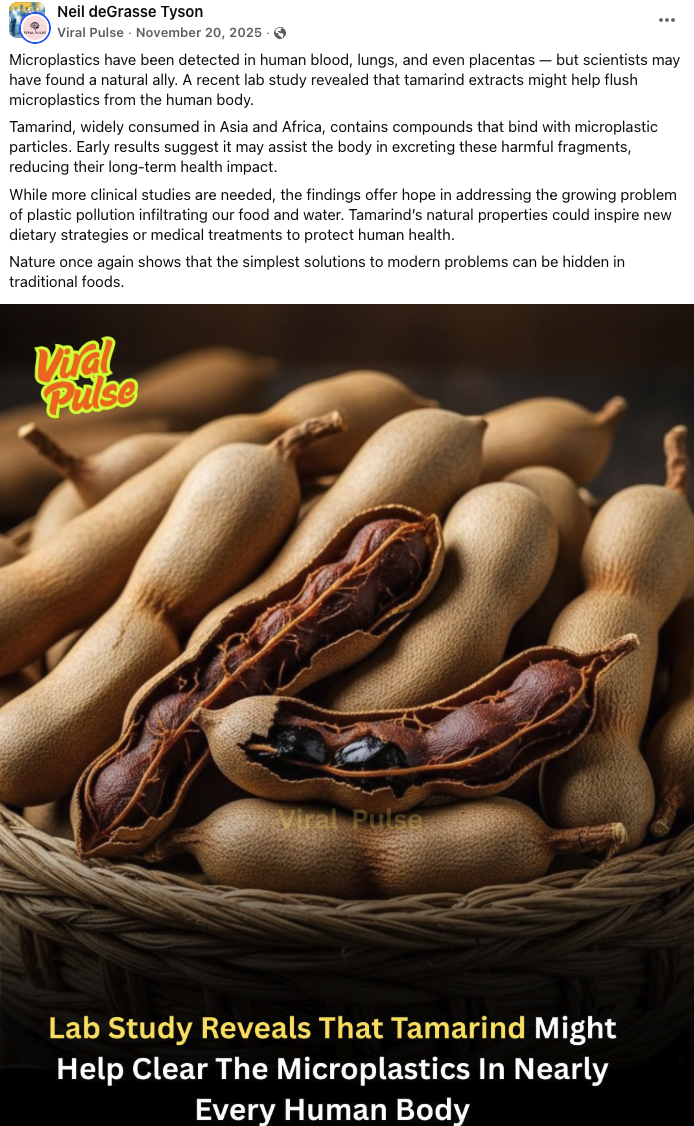
Over the last year or two, the claim has circulated widely online in different forms [1]. Tamarind can bind microplastics. Tamarind helps remove them from the body. Tamarind is nature’s answer to plastic exposure. People cite a study they cannot quite name, or gesture toward research they are sure exists somewhere. The confidence is often high. The sourcing is often low. Social posts on LinkedIn, Instagram, and Facebook now routinely repeat some version of the claim, often adding that tamarind may help the body “flush out” microplastics or that a “2024 study from India” proved it, even when no clear journal citation is provided.
So we went looking for it. For the actual thing. The paper. The experiment. The original source that could tell us what was truly found, what was merely suggested, and what the internet added on top.
What emerged was more interesting than a simple debunking. Because there does appear to be a real research signal here. But there also appears to be an internet leap. And between those two things sits the study nobody can seem to find.
The trail back to the first real source
The earliest source I could verify is not a health paper at all [2]. It is a 2022 ACS Spring conference presentation on plant derived polymers for removing microplastics from water. Tarleton State University and EurekAlert both summarized the work in March 2022. Their coverage said the researchers screened several plant extracts and found that okra paired with tamarind worked best for freshwater samples, while okra paired with fenugreek worked best for ocean water. An ACS meeting page also points to that same conference era presentation on freshwater samples using natural polysaccharides, including tamarind gum.
That 2022 presentation is still the earliest clear public anchor for the tamarind story. But it is no longer the only one. Since then, at least one peer reviewed paper has directly tested a tamarind based material against microplastics in water. In 2025, a ChemistrySelect paper reported that an acrylamide grafted tamarind polysaccharide could flocculate PVC microplastics under bench water conditions [3]. That matters because it moves tamarind beyond conference background and into the peer reviewed remediation literature. It still does not show that eating tamarind helps remove microplastics from the human body. But it does strengthen the narrower claim that tamarind derived materials belong in the environmental treatment conversation.
The 2025 paper that seems to have reignited the claim
The second major node appeared in 2025, when the same research group published a peer reviewed ACS Omega paper on okra and fenugreek as treatment agents for removing microplastics from water sources [4]. The paper reported that fenugreek performed best in groundwater, okra performed best in ocean water, and an okra plus fenugreek combination performed best in freshwater.
That is a meaningful result. We are naturally drawn to solutions that appear to work through physical interaction and binding, because that sticky mechanism is one of the most interesting ideas in the broader microplastics conversation, and one that resonates with Winnow’s own approach. However, tamarind was not part of this published paper. That does not necessarily invalidate the earlier 2022 signal. It simply means tamarind was not part of this particular study.
At nearly the same moment, ACS published a press summary of the paper [5]. That press item promoted the new okra and fenugreek work, but it also included background language saying that in earlier experiments researchers had found sticky natural polymers from okra, fenugreek, and tamarind could capture microplastics and clump them for removal from water. That background reference appears to point back to the 2022 meeting era work. This appears to be one of the key moments when separate layers of evidence were blended together in public memory.
In other words, the peer reviewed 2025 paper was real. The earlier tamarind signal was also real. The direct 2025 tamarind paper was real too. But these were not the same study, and the tamarind thread seems to have ridden the credibility of the later publication cycle into a much broader online claim.
The timeline of how the claim spread
Here is the clearest chronology I can reconstruct.
March 2022: the original signal
Tarleton State University, EurekAlert, and related conference coverage summarize a presentation from ACS Spring 2022 [2]. This is the first verifiable point where tamarind appears in a microplastics removal context. The claim is narrow: plant derived polysaccharides, including tamarind, can help remove microplastics from water, with okra plus tamarind performing especially well in freshwater.
March 2022: early science media pickup
Outlets like New Atlas amplify the conference result, again framing it as water cleanup and emphasizing that okra plus tamarind worked best in freshwater [6]. The claim is still mainly environmental at this stage.
Late 2024 to early 2025: adjacent tamarind science exists, but not the viral claim
Several later papers add an important layer to the story [3,7,8]. One is adjacent rather than microplastics specific: a 2024 paper on cationic tamarind seed polysaccharide as an effective flocculating agent in wastewater systems [7]. Another is directly relevant to microfibers and microplastics: a 2025 engineering paper used acid washed tamarind fruit shell carbon to treat laundering derived wastewater containing released microfibers and microplastics [8]. And most notably, the 2025 ChemistrySelect paper reported that a chemically modified tamarind polysaccharide could flocculate PVC microplastics in bench water conditions [3]. Taken together, these papers show that tamarind is not just a viral wellness ingredient in search of a citation. It has a real footprint in environmental remediation science. But this is still a very different claim from showing that eating tamarind removes microplastics from the human body.
May 2025: the strong peer reviewed paper arrives, but on okra and fenugreek
ACS Omega publishes the water treatment paper on okra and fenugreek [4]. ACS press coverage reintroduces tamarind in the background section by referencing earlier experiments [5]. That combination appears to have acted as an accelerant.
May to July 2025: secondary media flatten the distinction
Science news summaries, university reposts, and sustainability outlets spread the 2025 findings [9]. Some stay fairly accurate and focus on okra and fenugreek. Others start merging the earlier tamarind background into the 2025 paper itself, which makes it sound as though tamarind was part of the newly published journal result.
Late 2025: social media mutation phase
By late 2025, many LinkedIn, Facebook, and Instagram posts are no longer saying, “tamarind was part of an early water treatment experiment” [1]. They are saying “researchers found tamarind helps remove microplastics from the body,” “tamarind seeds cleared nearly 90%,” or “a 2024 study from India showed…” This is the stage where the claim becomes increasingly confident and increasingly detached from a verifiable paper.
October 2025 to early 2026: correction begins
A few later articles start trying to sort out the confusion [10]. Green Matters, for example, revisits the claim and notes that the real experimental thread is about tamarind extracts interacting with microplastics in controlled water experiments, while the broader body detox narrative remains unsupported. Another article states even more bluntly that there is currently no scientific evidence that eating tamarind cleanses plastic from blood, organs, or tissues.
The network and sharing map
The spread looks less like one clean citation chain and more like a relay race where each handoff slightly changes the claim. A nostalgic reminder of childhood and playing the telephone game.
Primary source layer
This is the foundation. It contains the narrowest and most defensible claims.
- 2022 ACS conference presentation: Natural plant polysaccharides were tested for microplastic removal from water. Tamarind appears here in the freshwater result [2].
- Tarleton and EurekAlert summaries: These made the conference work legible and shareable. They are not peer reviewed papers, but they are close to the original research communication [2].
- 2025 ChemistrySelect tamarind paper: A peer reviewed paper showing that a modified tamarind polysaccharide could flocculate PVC microplastics in bench water conditions [3]. This is narrower than a human health claim, but stronger than a conference era mention.
- 2025 ACS Omega paper: The peer reviewed paper centered on okra and fenugreek, not tamarind [4].
- 2025 ACS press summary: This is where the published paper and the older tamarind background appear together in one public facing narrative [5].
Secondary amplification layer
This is where the distinction starts to blur.
- University reposts and science outlets: Tarleton research pages, ScienceDaily style summaries, New Atlas, Sustainable Brands, Sci.News, and similar outlets spread the water treatment findings to broader audiences [6,9]. Some stayed close to the environmental framing. Others compressed multiple research phases into one cleaner story.
- Professional social reposts: LinkedIn, Facebook, and publisher adjacent social posts began to speak as though tamarind, okra, and fenugreek were all jointly validated in the new ACS Omega paper, even though the peer reviewed paper itself focused on okra and fenugreek [1].
Rumor mutation layer
This is where the claim becomes most shareable and least stable.
- Body detox framing: Posts begin saying tamarind may “help the body flush out microplastics,” “reduce accumulation,” or “bind plastics in the digestive system” [1]. These claims appear to be extrapolations rather than direct reflections of a traceable peer reviewed paper.
- Phantom citation phase: “A 2024 study from India” becomes a repeated citation formula, but across the sources I reviewed I could not verify a stable paper matching that exact claim [1]. The phrase seems to function more like a meme citation than a rigorous one.

What this shows
What makes the tamarind story so sticky is that it is not invented from nothing. It contains:
- a real 2022 research signal involving tamarind in water treatment
- a real peer reviewed tamarind specific paper showing PVC microplastic flocculation in bench water conditions
- a real 2025 peer reviewed paper on related plant polymers, but focused on okra and fenugreek
- real secondary coverage that brought those threads close together in public language
- then a wave of social reinterpretation that turned “promising environmental flocculation” into “natural human detox”
That does not make tamarind uninteresting. If anything, it makes the question more interesting, because tamarind now appears in both the remediation literature and the broader exposure conversation, even as the gut evidence remains missing.
So, while we have not yet seen strong peer reviewed evidence showing that dietary tamarind can bind microplastics in a clinically meaningful way, the tamarind story is not really about whether the internet lied. It is about what happens when a real early signal, a later peer reviewed paper in a neighboring lane, and a public hungry for nature based solutions all collide at once.
The result is not pure fiction. It is something more complicated and more human: a credible early signal that drifted into hope.
We have not yet seen the science come out showing that tamarind can bind to microplastics in the way people now imply online. I genuinely hope that changes one day. It would be exciting to have another strong, natural ingredient enter the conversation in a serious way.
References
- 1.↑Researchgate
- 2.↑AtlasPubMed
- 3.↑ScienceDirect
- 4.↑FDA
- 5.↑Openknowledge
- 6.↑ScienceDirect
- 7.↑WHO
- 8.↑Tarleton
- 9.↑ Secondary media and amplification examples: Goodnewsnetwork
- 10.↑ Later correction and sorting articles: Whatismicroplastics
- 11.AtlasPubMed
- 12.ScienceDirect
- 13.WHO
- 15.Ersj
- 16.AtlasPubMed
- 18.AtlasPubMed
- 19.ScienceDirect
- 20.MDPI
- 21.MDPI
- 22.AtlasPubMed
- 23.AtlasFrontiers
- 28.AtlasHpc
- 29.Arxiv
- 34.ACS
- 36.Sciencedaily
- 38.Phys
- 40.Newswise
- 41.Foodandwine
- 43.Washingtonpost
- 45.People
- 46.Sustainablebrands
- 47.Sci
- 51.Efsa
- 54.Joint-research-centre
- 55.Fao
- 57.Efsa
- 60.EPA
- 61.Linkedin
- 62.Linkedin
- 63.Linkedin
- 64.Instagram
- 65.Reddit
- 66.Reddit
- 67.Whatismicroplastics
- 68.Greenmatters
- 69.Wellnessplus
- 70.Rightforeducation
- 71.Thecooldown
Sign in to start a discussion.